
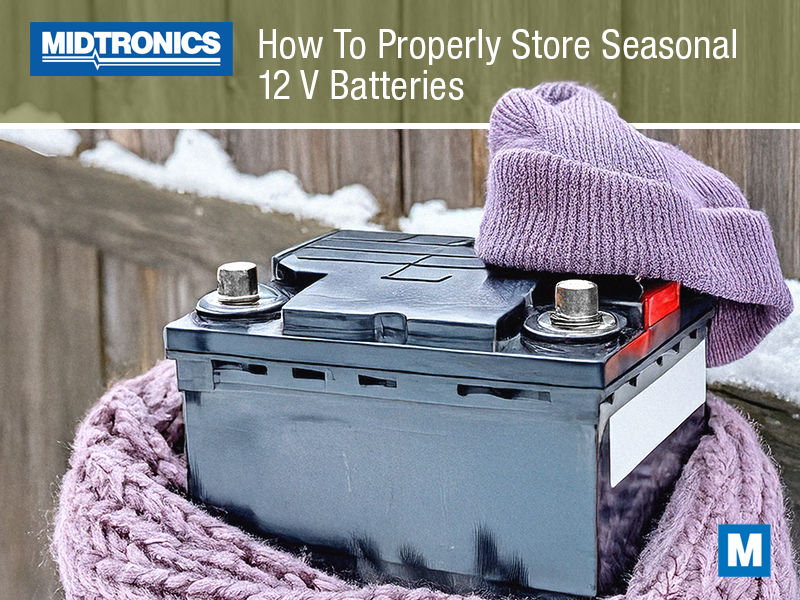
Not all vehicles are daily drivers, and an increasing number of customers have a vehicle that’s either summer-only or a winter ‘beater’. When a vehicle isn’t used for extended periods, the battery can experience issues affecting the vehicle’s readiness when it’s time to return to service, and the battery might also get damaged.
Key Takeaways
- Batteries left in stored vehicles self-discharge at 1–3% per week and can sulfate irreversibly if left below 50% charge for months.
- Remove the battery from stored vehicles or connect a smart maintainer — never leave a battery disconnected and fully discharged.
- Store batteries at 50–80% charge in a cool, dry location (40–65°F ideal); avoid concrete floors and freezing temperatures.
- Test battery health with a conductance tester before returning a stored vehicle to service — a winter in storage often reveals hidden weakness.
Walk through the necessary steps to properly store 12-volt batteries for seasonal vehicles, prevent battery damage, and how to integrate this knowledge into a auto repair and service business.
What Happens When an Installed Battery Isn’t Used for Months
When a 12-volt battery sits unused for extended periods, it undergoes various chemical and physical changes that can impact its performance and lifespan. All batteries experience self-discharge over time, slowly losing their charge even if not connected to a load. In a stored vehicle, this natural discharge can reduce a battery’s charge to a point where it becomes incapable of starting the engine.
Sulfation is a common problem that occurs in stored vehicles when a battery remains undercharged for an extended time, typically months. Lead sulfate crystals accumulate on the battery’s plates, reducing the surface area available for chemical reactions. This results in diminished capacity and can permanently damage the battery.
Inactive batteries are still prone to corrosion at the terminals, which can lead to poor electrical connections. This corrosion is often accelerated by humidity or temperature fluctuations.
If a battery is allowed to completely discharge over several months, it can experience deep discharge, which is harmful and may require a full battery replacement.
These issues can cause serious delays in returning a vehicle to service, especially in periods where the shop capacity is high – such as the start of a new season.
Types of Seasonal Vehicles Affected
Different types of seasonal vehicles can be impacted by improper battery storage. Here’s a list of common vehicles that are typically affected by long storage periods:
- Boats often sit in storage during the winter months when boating activity decreases, leaving batteries unused for months.
- Motorcycles get stored during colder months or when conditions are less favorable for riding. Their smaller 12-volt batteries are particularly susceptible to self-discharge and sulfation.
- RVs are often used seasonally for camping or vacations and may sit unused for extended periods in the off-season, which can drain the batteries.
- Classic cars and collector vehicles are used sparingly and stored for much of the year, requiring careful attention to battery storage.
- Snowmobiles and off-road vehicles get stored for long periods when not in season, which can lead to deep discharge and sulfation.
- Tractors and other machinery used seasonally may sit for months without use, affecting battery performance when the equipment is needed again.
In these scenarios, it’s possible that the battery will need to be replaced rather than simply recharged. It’s frustrating for owners as the battery typically should’ve had a longer lifespan than it did – sometimes only lasting a single season.
Steps to Properly Store 12-Volt Batteries
To ensure 12-volt batteries stay viable for as long as possible, these steps should be followed:
- Remove the battery if possible. Removing the battery from the vehicle is one of the most effective ways to keep it healthy during storage, minimizing the risk of parasitic drain from onboard systems and makes it easier to maintain the battery’s charge.
- Clean the terminals. Before storage, clean the battery terminals to remove any corrosion or build-up to maintain a good electrical connection when the battery is put back into use.
- Fully charge the battery. Before placing the battery in storage, it should be fully charged using a suitable charger. A fully charged battery is less prone to sulfation and self-discharge.
- Store in a cool, dry place. Temperature plays a significant role in battery performance. Batteries should be stored in a cool and dry environment, ideally between 50°F and 77°F (10°C to 25°C). Extreme temperatures, especially heat, can accelerate self-discharge and increase the risk of corrosion.
- Use a battery maintainer. A battery maintainer (or trickle charger) is an excellent tool to prevent charge loss over time. These devices monitor the battery’s voltage and apply a small charge when necessary, keeping the battery topped off without overcharging it.
- Check the battery regularly. Periodically check the battery’s voltage and condition during the storage period, ideally every one to two months. This will allow you to detect any issues early, such as a loss of charge or signs of sulfation, and take corrective action before it’s too late.
How to Integrate the Information into an Automotive Service Business
For auto service facilities, offering battery storage services can be a valuable addition to your business model. Here’s how to leverage this information for your service shop.
Offer battery maintenance as part of seasonal services
Many customers store their vehicles for the season, making battery care an essential service. By offering battery storage and maintenance packages, you can attract more customers during both peak and off-peak seasons.
Educate customers on the importance of battery care
Informing your customers about the risks of improper battery storage and the steps they can take to protect their vehicle’s battery can set your business apart. This not only helps customers avoid costly battery replacements but also strengthens customer loyalty.
Use diagnostic tools for battery health assessments
Integrating Midtronics battery diagnostic tools into your service offerings will enhance your ability to assess battery health and provide accurate recommendations. Battery checks should be a standard part of seasonal vehicle inspections, giving your customers peace of mind.
Offer battery testing and charging services
If a customer’s vehicle has been in storage for a long time, offering a battery diagnostic test and recharge as part of your service package will help ensure that the vehicle is ready to hit the road. This can be particularly appealing for seasonal vehicles such as motorcycles, boats, and RVs.
Conclusion
Storing 12-volt batteries properly is a key aspect of maintaining seasonal vehicles. By understanding what happens when a battery is left unused for months and implementing the right storage practices, you can extend battery life and enhance customer satisfaction.
By following these best practices and educating your customers, you can help prevent common battery issues and ensure that seasonal vehicles are always ready to hit the road when the time comes.
Frequently Asked Questions
How long can a car battery sit before it goes dead?
Most batteries will self-discharge enough to fail to start a vehicle within 4–8 weeks if left without any maintenance. In cold weather, this happens faster because cold temperatures increase internal resistance and reduce available capacity. A smart maintainer eliminates this problem entirely.
Should I remove the battery from a vehicle in seasonal storage?
It depends on how long the storage is and your setup. For storage under 3 months, a battery maintainer connected to the vehicle is often easier. For longer storage or if you don’t have access to power, removing the battery and storing it separately with a maintainer is the safest approach.
What’s the best way to store a car battery when not in use?
Store the battery at 50–80% charge in a climate-controlled space — ideally between 40°F and 65°F. Avoid direct concrete contact (place on wood or a rubber mat), keep it away from metal objects that could cause a short, and connect a smart float charger if possible to maintain charge during storage.
Does cold weather damage a stored battery?
Yes. A fully charged battery resists freezing down to around -75°F, but a discharged battery can freeze at 20°F. Freezing causes the electrolyte to expand, warping or cracking the plates permanently. This is why maintaining charge during winter storage is critical — not just for starting, but for physical preservation of the battery.
How do I know if a battery survived storage?
Voltage alone isn’t enough. After charging the battery fully, run a conductance test to assess the plate condition. Batteries that spent months in a discharged state often show significantly reduced conductance even after recharging, indicating permanent sulfation damage that will lead to early failure.
Can a battery maintainer damage a battery if left on too long?
A smart maintainer/float charger will not damage a healthy battery — it switches to maintenance mode once the battery is full and only tops it off as needed. A basic unregulated charger, however, left connected indefinitely will overcharge and damage the battery. Always use a smart maintainer for long-term storage.